Major gifts—the largest individual contributions your organization receives—are one of the most significant sources of nonprofit revenue. Many organizations find that 80% of their individual donation revenue comes from just the top 20% of their donors. In some cases, the ratio is closer to 90/10!
What constitutes a major gift will vary based on your nonprofit’s unique size and scope. However, the importance of these gifts is the same across the board—they provide funding for the largest, most impactful initiatives your organization runs, from launching new programs to expanding your facilities so you can serve more community members.
In this guide, we’ll discuss five of the best strategies to level up your organization’s major donor fundraising efforts, including how to:
- Assemble a Major Gifts Team
- Conduct Thorough Prospect Research
- Boost Your Impact With AI Tools
- Build Lasting Relationships With Major Donors
- Make the Most of Challenge Match Campaigns
With a solid strategic foundation and the right technology in your nonprofit’s toolkit, you’ll be well on your way to securing more major gifts and bringing high-impact donors into the fold for the long run. Let’s get started!
1. Assemble a Major Gifts Team
If you want to be more intentional about seeking out and securing major gifts, you’ll need to start a major giving program for your nonprofit. You’ll likely start your program by assigning or hiring one team member to serve as your lead major gifts officer, but you should eventually expand your team to include more officers.
When selecting your first major gifts officer, choose someone with extensive fundraising experience who is comfortable meeting one-on-one with potential donors and directly asking them for large contributions. Their key responsibilities will typically include:
- Conducting prospect research (more on this below!)
- Handling initial outreach to prospective donors
- Developing and executing tailored communication plans for each donor and prospect
- Drafting and presenting fundraising appeals
- Following up with donors to maintain strong relationships (more on this later, too!)
- Tracking and analyzing various types of data related to major giving
To help your major gifts officers excel in their efforts, provide various opportunities for them to develop their professional skills, such as attending conferences or taking online certification courses. It’s also useful for your first major gifts officer to receive management training as you expand your team, so they can lead it effectively.
2. Conduct Thorough Prospect Research
DonorSearch’s prospect research guide defines the term as “a technique used by nonprofit fundraisers, major gift officers, and development teams to identify high-impact donors within and beyond an organization’s current donor pool. Through this process, nonprofits gather an immense amount of data—information about donors’ backgrounds, past giving histories, wealth indicators, philanthropic motivations, and more.”
Although prospects need to have the financial resources to make a significant contribution to your organization, wealth alone isn’t enough to make someone a good major donor candidate. Use a comprehensive prospect research database to look for three types of indicators for each potential donor:
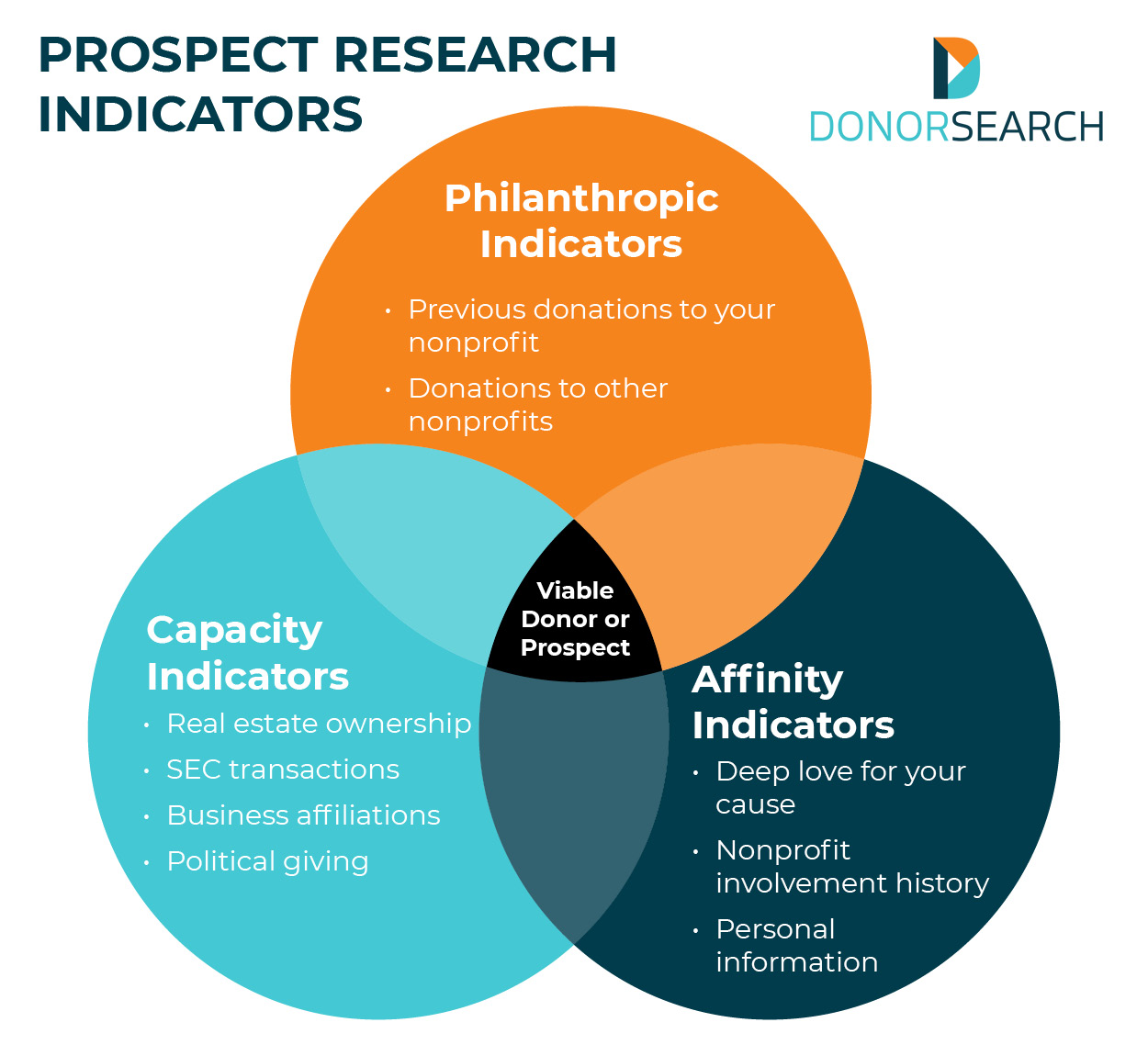
- Capacity indicators show that a prospect has the financial means to make a major gift. They include things like real estate ownership, SEC transactions, business affiliations, and a history of political giving.
- Philanthropic indicators demonstrate that a prospect has charitable tendencies and include previous donations to your nonprofit and other similar organizations.
- Affinity indicators signal a prospect’s willingness to support your mission in significant ways. They include a deep love for your cause; a history of nonprofit involvement through volunteering, event attendance, or board service; and personal information like interests, values, and family connections.
Once you’ve found a prospect with all three types of indicators, your major gifts team should start reaching out to them so they can build a relationship and get a better sense of whether they’d be a good fit for your major giving program.
3. Boost Your Impact With AI Tools
If your nonprofit finds several viable prospects through its research, it can be challenging to decide which of them would be best to contact first. You may also find it tricky to create tailored communications for each of them. Fortunately, you can easily streamline these processes by leveraging solutions powered by artificial intelligence (AI).
There are a variety of AI tools for nonprofits you could incorporate into your major donor fundraising strategy, but these three types tend to be most effective:
- Predictive modeling solutions use machine learning to identify patterns in your prospect research data. They then prioritize your prospect lists based on which individuals are most likely to respond to outreach and convert so you can use your time and resources wisely.
- Prospect reporting tools that are equipped with generative AI capabilities consolidate data on individual prospects into detailed, actionable reports that your major gift officers can reference as they determine the best strategy for contacting and following up with each potential donor.
- Content generation platforms produce original content like email templates, direct mail copy, and talking points for phone calls. You can then edit these outputs to develop tailored communications for each prospect, allowing you to execute your major gift moves management strategy more quickly and successfully.
To allow for seamless data transfer, make sure your various AI tools integrate with each other. For example, DonorSearch Ai (the leading predictive modeling solution for the nonprofit sector) integrates with Momentum (a nonprofit-specific content generation platform) so your prospect research data automatically informs your communications.
4. Build Lasting Relationships With Major Donors
Although technology is critical for effective major donor fundraising, prospects are most likely to contribute to organizations that put in the work to develop genuine, personal relationships with them. Here are some ways your major giving team can effectively cultivate donors:
- Meet with prospects one-on-one. Use this time to introduce the prospect to your nonprofit and get to know them more deeply. Take note of the personal details they discuss during this meeting so you can bring them up in follow-ups. For example, if a prospect mentions that their son Alex is leaving for college in a few weeks, asking how move-in went and how Alex is settling in when you talk to them next month shows that you were listening and care about their lives.
- Demonstrate your organization’s impact. Send each prospect resources that show your past successes and the progress you’ve made on current initiatives to instill confidence in them that you’ll use their contributions to continue furthering your mission. If they show interest in specific programs or projects, introduce them to the team members in charge of those initiatives so they can provide more information.
- Offer various engagement opportunities. It’s often helpful to make several smaller asks of potential major donors leading up to your main donation request rather than presenting them with a fundraising appeal for a significant amount right away. Plus, inviting prospects to volunteer, attend events, or consult on projects that align with their professional expertise gives them insight into your nonprofit’s inner workings that can increase their trust in you and their interest in contributing to your mission.
There is no set time to make a major gift fundraising ask—you’ll need to monitor your progress with each prospect to determine when to present your fundraising appeal. Your relationship-building efforts also shouldn’t end when a prospect converts. According to Winspire, effective donor stewardship can lead to improved retention rates and higher donor lifetime values as supporters who feel appreciated contribute again and again.
5. Make the Most of Challenge Match Campaigns
One of the most powerful ways to leverage a major donor is not just to accept their check, but to use it to inspire others. For this reason, a challenge match campaign involves a major donor (or a group of donors) agreeing to match donations made by other supporters during a specific timeframe. This strategy gamifies the giving experience and creates a sense of urgency.
These campaigns are highly effective because they tap into a donor’s desire to maximize their impact. According to Double the Donation’s challenge grant statistics, more than 84% of donors say they are increasingly likely to donate if a match is offered, and one in three donors indicate they would give a larger gift if matching is applied. By positioning your major donor’s gift as a matching challenge, opportunity you amplify the value of their contribution significantly.
The Role of Challenge Matches in Capital Campaigns
Challenge matches are particularly vital during capital campaigns. A capital campaign is a rigorous effort to raise a large sum of money within a defined period, usually for a specific project like a new building or an endowment. Major gifts are the fuel for these campaigns, but challenge matches can act as the accelerator.
For the best results, you can utilize major gifts in capital campaigns in the following ways:
-
Kick-starting the public phase: Use a major gift to launch the public phase of your campaign. Announcing that a major donor will match the first $100,000 raised from the community creates immediate momentum.
-
Closing the gap: Toward the end of a campaign, energy often lags. A major donor can issue a “finish line” challenge to motivate smaller donors to help reach the final goal.
-
Unlocking tiers: Structure the challenge so that hitting certain milestones unlocks additional funds from the major donor. This keeps supporters engaged throughout the duration of the campaign.
When you present this option to a major donor, it elevates their status. They become a partner in your fundraising success rather than just a one-time funder. It allows them to see their influence in real-time as other donors flock to participate in the challenge they made possible.
Using a robust fundraising tool helps you track these pledges and matches accurately. Ensure you have a system in place to report back to the major donor exactly how much money their initial gift helped raise.
Major donor fundraising is vital for your nonprofit, but getting your major giving program started or refining it can be challenging. Use these four strategies as a starting point to make improvements that will help you bring in more donations and continue to fund your mission over time.